
Mango & Ginger Foam for Cocktails: Quick Guide, Recipe, and Fixes
Updated: May 13
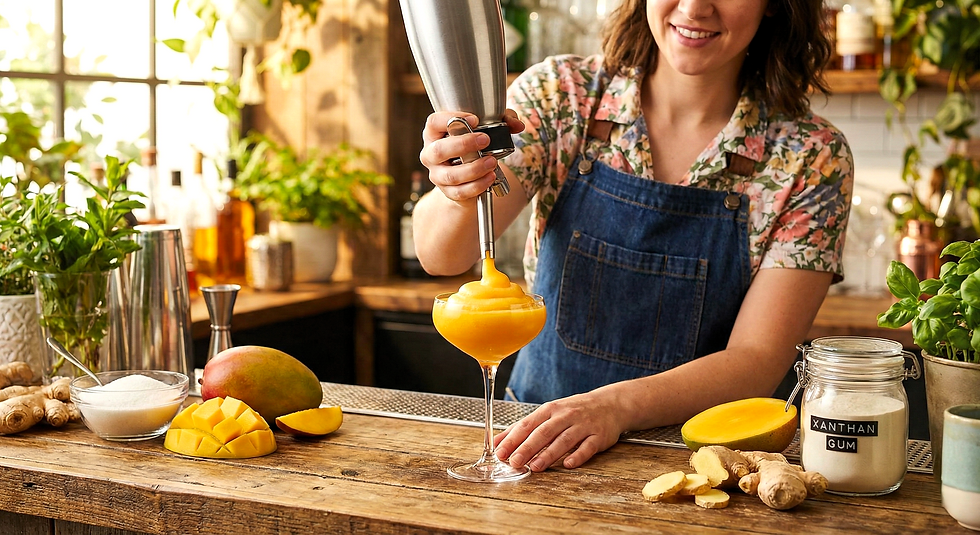
Mango and ginger foam is a fast, high-impact topper for cocktails. It adds aroma, sweetness, gentle heat, and a creamy mouthfeel without changing the drink’s liquid volume too much. When it is done well, it dispenses smoothly from a siphon, sits as a neat cap, and stays stable long enough to serve and enjoy the drink.
This guide explains how to make mango and ginger foam using a 1 L siphon, with a precise xanthan gum percentage, a clear recipe method, and practical troubleshooting for common failures like clogging, watery foam, and uneven texture.
Beginner quick guide
Use mature, ripe mango for body and sweetness. Thin or under-ripe mango can taste sharp and produce weak foam.
Juice ginger and fine strain it to prevent clogs in the siphon nozzle.
Dissolve sugar completely before adding xanthan gum.
Weigh the full mixture, then add xanthan gum at 0.5% of the total weight.
Blend for 2 minutes, then rest the mixture for 30 minutes to reduce trapped air.
Charge a 1 L siphon with 2 N₂O cartridges, shaking 10 seconds after each charge.
Chill at least 1 hour before service and shake occasionally while chilling.
Dispense upside down and release slowly for a clean, stable cap.
What mango and ginger foam is
In simple terms, cocktail foam is gas bubbles held inside a flavored liquid structure. A siphon (also called a cream whipper) pushes gas into the mixture under pressure, then releases it to create a foam when dispensed.
Foam quality depends on:
The base texture (too thin collapses, too thick clogs)
The amount of dissolved gas (charging, shaking, and chilling)
Stabilization (a small amount of stabilizer helps the foam hold its structure)
This recipe uses xanthan gum as the stabilizer.
Why xanthan gum is used
Xanthan gum is a food-grade thickener and stabilizer used at very low percentages. It increases viscosity, which slows separation and helps the foam hold a smoother, more stable structure. It also has shear-thinning behavior, meaning it flows more easily when blended or pushed through a nozzle, then thickens slightly at rest. This is useful for siphon service: easy dispensing, then a stable cap.
Equipment and setup
1 L siphon (cream whipper)
2 N₂O cartridges (nitrous oxide chargers)
Juicer (for mango and ginger)
Fine strainer (mandatory for ginger juice)
Digital precision scale (mandatory for xanthan dosing)
Blender (immersion blender or jug blender)
Funnel (optional)
Basic workflow rules:
Keep fibrous solids out of the siphon to prevent clogging.
Respect the device’s maximum fill level.
Keep the siphon cold during service for tighter, more stable foam.
Recipe card: Mango and Ginger Foam (1 L siphon)
Yield: 1 L siphon
Time: about 2 hours total (includes resting and chilling)
Technique: blended xanthan-stabilized siphon foam
Use: cocktail topper
Ingredients (ml first, then oz)
350 ml (11.83 oz) mango puree
40 ml (1.35 oz) ginger juice, fine strained
200 ml (6.76 oz) filtered water
70 ml (2.37 oz) fresh lemon juice
80 g (2.82 oz) white caster sugar
Xanthan gum: 0.5% of the total final weight
2 N₂O cartridges for a 1 L siphon
Method
Juice mature mangoes and collect the puree. Fine straining the mango is not required in this spec.
Juice peeled ginger, then fine strain the ginger juice.
Combine mango puree, ginger juice, water, lemon juice, and sugar.
Stir until the sugar is completely dissolved.
Weigh the total mixture in grams.
Add xanthan gum at 0.5% of the total weight.
Blend for 2 minutes until the xanthan is fully dispersed.
Rest the mixture for 30 minutes.
Pour into a 1 L siphon.
Charge with the first N₂O cartridge and shake for 10 seconds.
Charge with the second N₂O cartridge and shake for another 10 seconds.
Chill the siphon for at least 1 hour, shaking from time to time.
Before service, shake again, hold upside down, and dispense slowly into the glass.
Homemade ingredients should not only taste good during R&D. They need to survive real service.
The Bar-Ready Homemade Ingredients Masterclass teaches how to design, produce, store, test, and standardize homemade preps with better structure, shelf-life logic, SOPs, and quality control.
Garnish standard
The foam is the garnish. Aim for a neat, centered cap with clean edges. Avoid drips on the rim.
Dilution and temperature notes
This is a topper, not a stirred or shaken drink component. Temperature matters more than dilution. A colder base holds gas better and produces a tighter foam. Chill fully before service.
Tasting notes
Bright mango aroma, sweet-tart citrus lift, and a ginger finish that reads as warm spice rather than aggressive burn. Creamy mouthfeel, clean finish.
Batching and prep notes
Always weigh the full mixture before adding xanthan.
Always fine strain ginger juice to reduce clog risk.
If mango puree is unusually fibrous, passing the mixture through a fine sieve before filling the siphon can improve reliability.
Xanthan dosing made simple (0.5% by weight)
This recipe uses a strict rule: xanthan gum equals 0.5% of total mixture weight.
Practical formula:
Total mixture in grams × 0.005 = grams of xanthan gum
Worked example:
450 g mixture needs 2.25 g xanthan gum
A precision scale is essential. Small errors matter because the range is tight.
Key points that make it work
These are the steps that most often decide whether the foam is smooth and stable or watery and inconsistent.
Fine strain ginger juice every time. Ginger fibers are the most common cause of clogging.
Dissolve sugar fully before xanthan. Undissolved sugar can create uneven texture.
Dose xanthan by weight, not by spoons. 0.5% is a small number and precision matters.
Blend hard and long enough. Two minutes is there to fully disperse the xanthan.
Respect the rest time. Resting reduces trapped air and usually improves the final cap.
Keep it cold. Warm siphons and warm bases give bigger bubbles and faster collapse.
Dispense slowly with the siphon upside down. Fast dispensing breaks structure and looks messy.
Quality control checks (fast and practical)
Use these checks before service:
Texture check: foam should be smooth and glossy, not watery, not gummy.
Hold test: a small cap on a test glass should keep shape long enough to garnish and serve.
Dispense behavior: flow should be steady. Sputtering suggests solids, insufficient chilling, or inconsistent shaking.
Taste check: mango-forward with clear ginger lift and citrus brightness.
How to use it on a cocktail
Mango and ginger foam works best as a final top layer on a cold drink. It pairs well with:
Bitter components (amaro, aperitivo-style builds)
Warm spice notes (whisky, aged rum, some agave styles)
Bright citrus structures (especially lemon-forward builds)
For service, dispense slowly to avoid breaking the foam structure. A controlled cap looks cleaner and lasts longer.
Want drinks like this built for real menu use?
The Double Strainer develops service-ready cocktail menus designed for concept fit, consistency, and smoother execution.
Substitutions and acceptable swaps
These swaps are beginner-safe, but they change balance. Adjust carefully.
Mango puree: fresh mango puree or smooth commercial mango puree. If the puree is very thick, add a small amount of extra water to keep the base pourable.
Caster sugar: fine granulated sugar is acceptable. Dissolve fully before xanthan.
Lemon juice: lime can substitute, but it will read sharper and more aromatic.
Ginger juice: fresh is best. A strong ginger syrup can replace part of the ginger, but it increases sweetness and can mute fresh ginger bite. If using syrup, reduce sugar and re-taste.
Troubleshooting and fixes
1) Foam is watery and collapses quickly
Likely causes: insufficient chilling, under-shaking, base too thin due to mango quality.
Fix: chill longer, shake again before service, use mature mango. Confirm xanthan calculation and blending time next batch.
2) Foam is too thick, gummy, or “snotty”
Likely cause: too much xanthan, or an unusually thick mango base.
Fix: re-weigh and dose xanthan exactly at 0.5% next batch. If mango puree is extremely thick, slightly increase water rather than increasing xanthan.
3) Nozzle clogs or sputters
Likely causes: ginger not fine strained, fibrous mango, incomplete blending.
Fix: fine strain ginger every time, blend for the full 2 minutes, rest 30 minutes, and sieve before filling if needed.
4) Foam has large bubbles and looks rough
Likely causes: not rested, too warm, inconsistent chilling.
Fix: rest the base 30 minutes, chill at least 1 hour, keep the siphon cold during service.
5) Foam tastes too sweet or too sharp
Likely cause: mango ripeness and juice variability.
Fix: adjust next batch by small steps. Reduce sugar if using sweetened puree. Increase lemon slightly if the foam tastes flat and sweet. Keep sugar fully dissolved before xanthan.
6) Foam separates inside the siphon
Likely causes: sugar not fully dissolved, uneven xanthan dispersion.
Fix: dissolve sugar completely, blend thoroughly, follow rest and chill steps consistently.
If there are questions about making foams properly and consistently, read the related foam guide in the Techniques section
Glossary
Foam: gas bubbles held in a liquid structure, creating an airy texture.
Siphon (cream whipper): a pressurized canister used to aerate liquids with gas cartridges.
N₂O: nitrous oxide used in cartridges to create foams in siphons.
Xanthan gum: a food-grade stabilizer and thickener used at very low percentages.
Shear-thinning: thick at rest, flows more easily when pushed through a nozzle.
Fine strain: straining through a fine mesh to remove fibers and particles.
Hydration (of xanthan): fully dispersing the gum in the liquid to create a uniform texture.
Resting: waiting after blending so trapped air reduces and texture stabilizes.
Read next and stay updated
For more prep components like syrups, cordials, infusions, and service-ready bases, explore the Homemade Ingredients section.
To get one new service-ready article each week, subscribe to the Newsletter.
Written by: Riccardo Grechi | Head Mixologist, Bar Consultant & Trainer


Comments