top of page

Optimizing Flavor Extraction in Cocktails Through Sous Vide

  • Jun 15, 2025
  • 5 min read

Updated: 4 days ago

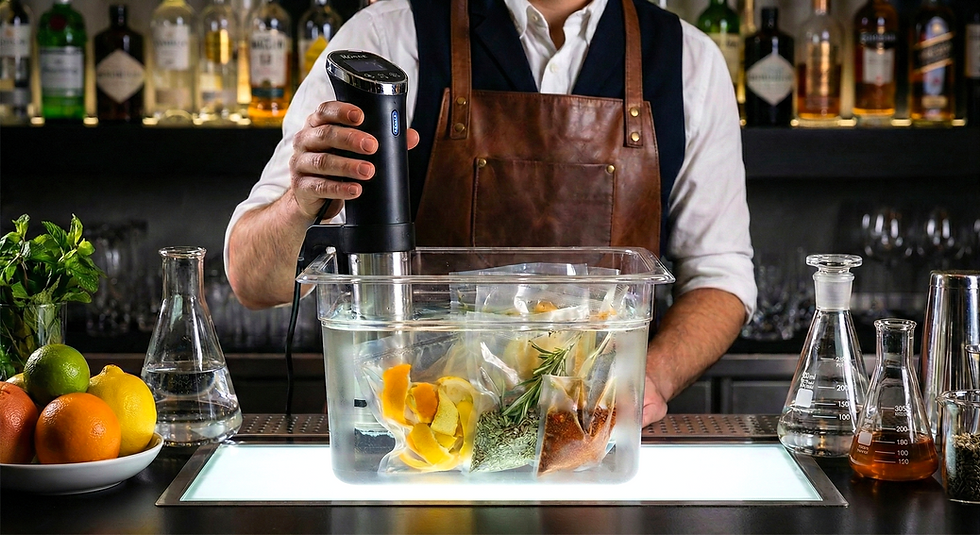
A bartender in a leather apron uses a sous vide immersion circulator to prepare infusions in a water bath filled with vacuum-sealed bags of citrus peels, herbs, and spices on an illuminated bar counter. Fresh fruit and glass lab equipment, including beakers and flasks, are arranged around the setup.

Quick Definition: What It Is

A Roner is an immersion circulator used to hold a water bath at an exact temperature for sous vide work. In cocktail bars, it is often used to create controlled infusions, syrups, and flavor extractions with repeatable results.

Sous vide, a French term commonly translated as “under vacuum,” refers to sealing ingredients in a bag or jar and using a temperature controlled water bath to cook or infuse evenly at relatively low temperatures.


Why It Matters (for bartenders and drinkers)

For bartenders, sous vide turns “infusion” from a vague prep into a spec. Temperature and time become controllable variables, which improves consistency and reduces batch-to-batch drift.

For drinkers, the payoff is clearer flavor intent: brighter aromatics when that is the goal, cleaner spice extraction when warmth is desired, and a more consistent experience across repeat orders.


Key Elements

Equipment

  • Immersion circulator (often referred to as a Roner in bar contexts)

  • Water bath container (Cambro or stock pot)

  • Bag or jar system: vacuum bags or heat-safe zip bags, or a well-sealed jar

  • Timer and basic labeling system

Ingredients

  • Base liquid: spirit, fortified wine, syrup base, or water depending on the goal

  • Aromatics: citrus peels, herbs, spices, tea, fruit, coffee, etc.

  • Optional: fine straining materials (fine mesh plus coffee filter) for clarity and texture polish


How It Works

Traditional infusions rely on time and ambient temperature. Sous vide adds precision.

  1. Sealed environment reduces oxidation and keeps volatile aromas more contained compared with open steeping.

  2. Stable temperature increases extraction speed and makes outcomes repeatable, especially when a bar needs the same result every service.

  3. Time plus temperature pairing lets the extraction land where it tastes best: clean, rounded, and intentional rather than randomly “strong.”


Typical infusion ranges (practical baseline): Many sous vide alcohol infusions are run roughly within 55°C to 71°C (131°F to 160°F) for about 1 to 3 hours, adjusted by ingredient intensity and desired profile. This is not a rigid rule. Delicate botanicals often benefit from lower temperatures and shorter times.


Technique and Execution: Step by Step Roner Infusions


Step 1: Prep the ingredients

  • Choose fresh, high quality produce and aromatics. Quality sets the ceiling for flavor.

  • Pre-measure and pack ingredients with the base liquid.

  • Seal in a vacuum bag or use a high quality zip bag designed for sous vide. A vacuum sealer helps remove air for more even contact.


Step 2: Set the water bath

  • Preheat the bath to the target temperature.

  • Submerge the sealed bag or jar fully. Minimize trapped air so the contents heat evenly.


Step 3: Run the infusion

  • Start a timer immediately once the product reaches temperature.

  • Keep temperature stable and avoid “topping up” with cold water that swings the bath.

  • Stop early if the aroma is already where it needs to be. Pushing time is a common way to drift into dull or overly cooked notes.


Step 4: Chill, strain, store

  • After infusion, cool promptly in an ice bath to halt extraction and bring the product down fast.

  • Strain solids out and filter finer if a cleaner texture is desired.

  • Bottle, label (date, batch, parameters), and refrigerate.


Applications in Cocktail Making

1) Enhanced flavor extraction

Sous vide helps capture subtle aromatics while managing harshness by controlling temperature and time. This is especially useful for:

  • Citrus peel infusions where bitterness can spike unpredictably

  • Herb infusions where “fresh” can turn “stewed” if pushed

  • Spice infusions where warmth is desired without astringency


2) Consistency and reproducibility

In service, consistency matters as much as creativity. Sous vide supports repeatable outcomes because the parameters are measurable and replicable.


3) Experimentation and R&D speed

When building a menu, sous vide offers a controlled testing environment. Changing one variable at a time (temperature, time, cut size, ratio) makes the result easier to diagnose and improve.


4) Better handling of delicate ingredients

Lower temperature options can preserve lighter aromatics compared with aggressive hot steeping.


Vanilla and Cardamom Infused Rum (Sous Vide)

Recipe Card

  • Yield: 500 ml (16.91 oz)

  • Prep time: 5 minutes

  • Method: Sous vide infusion, then chill and strain

  • Glassware: None (prep)

  • Ice: Ice bath for rapid chilling

  • Garnish: None


Tools

  • Roner (immersion circulator)

  • Water bath container

  • Vacuum bag plus vacuum sealer (helpful, not mandatory)

  • Bowl for ice bath

  • Fine strainer

  • Bottle


Ingredients

  • 500 ml (16.91 oz) aged rum (example styles: medium-bodied aged rum)

  • 1 vanilla bean, split lengthwise

  • 3 cardamom pods, lightly crushed


Procedure

  1. Preheat the water bath to 62°C (144°F).

  2. Combine rum, vanilla, and cardamom in a vacuum bag and seal. A well-sealed jar is an alternative.

  3. Submerge and infuse for 2 hours. This sits within a common working range for sous vide alcohol infusions.

  4. Remove and chill the sealed bag or jar in an ice bath to stop extraction quickly.

  5. Strain, bottle, label, and refrigerate.


Dilution and temperature notes

  • No dilution is intended in the infused rum itself.

  • Serve temperature depends on the final cocktail spec. For stirred drinks, the infusion will express best when properly chilled and diluted in mixing.


Common Mistakes

  • Treating sous vide like a shortcut without specs: no ratios, no time, no labels, no repeatability.

  • Over-extraction by defaulting to “longer is better”: longer time can mute aromatics or pull unwanted bitterness.

  • Poor sealing or trapped air: uneven contact leads to uneven extraction.

  • Skipping rapid chilling: extraction continues while cooling slowly, shifting balance.

  • No filtration standard: inconsistent texture and haze between batches.


Pro Tips and Professional Notes

  • Build a simple internal spec sheet: ingredient ratio, cut size, temperature, time, filtration, and tasting notes.

  • For a new ingredient, start conservative: lower temperature, shorter time, then increase deliberately.

  • Use sous vide when the goal is repeatability. For fast prototyping, consider rapid infusion with a siphon as a complementary tool.Rapid Infusion with a Cream Whipper: How Modern Bars Speed Up Flavor Extraction 


Variations and Substitutions

  • Base spirit swaps: rum can be replaced with whiskey, brandy, or tequila for different structures. Keep temperature and time conservative until tested.

  • Spice swaps: cardamom can be replaced with cinnamon, star anise, cacao nibs, or toasted coriander. Harder spices often need either slightly more time or a higher temperature.

  • Vanilla format: whole bean gives a cleaner profile than extracts, but availability and cost vary by market.


FAQ

  1. Is a Roner different from any sous vide machine?

    A Roner is commonly used to describe an immersion circulator that holds water at a set temperature. Many brands exist and function similarly for bar prep use.

  2. Does sous vide always require vacuum sealing?

    Vacuum sealing is common, but sealed zip bags or well-sealed jars are also used. The key is a sealed environment and stable temperature control.

  3. What temperatures work best for spirit infusions?

    A common practical range is about 55°C to 71°C (131°F to 160°F), usually for 1 to 3 hours, adjusted for ingredient intensity.

  4. Why chill in an ice bath after infusion?

    Rapid chilling stops extraction quickly and brings the product down fast before storage.

  5. Is sous vide better than traditional jar infusions?

    Not always. Sous vide is strongest when repeatability and controlled extraction matter. Traditional infusions can be excellent when time is available and the bar has stable prep routines.

  6. Can sous vide be used for syrups?

    Yes. The same temperature control can help infuse sugar syrups or honey syrups with aromatics, then strain and store.

  7. How is sous vide different from rapid infusion?

    Rapid infusion uses pressure for speed, while sous vide uses temperature control for precision and repeatability. Both can live in the same prep system.

  8. What is the fastest way to improve results?

    Write down parameters, taste at checkpoints, and label every batch.


Explore more like this: Browse Techniques for step-by-step methods that hold up in real service.

Stay updated: Subscribe via Newsletter for new technique guides, recipes, and bar systems.


Written by: Riccardo Grechi | Head Mixologist, Bar Consultant & Trainer

Comments


bottom of page