
Cocktail Design: A Practical System for Creating Better Drinks
- 15 hours ago
- 25 min read

Cocktail design is often mistaken for visual flair, garnish work, or the search for something that looks original. Those elements matter, but they are not the foundation. A well-designed drink is not simply attractive or unusual. It is a drink built with purpose, shaped to perform properly for the guest, the venue, the menu, and the team behind the bar.
That is where this Masterclass begins.
Real cocktail design is the discipline of making better decisions before a drink ever reaches the guest. It is about choosing the right structure, understanding ingredient roles, controlling perception, testing prototypes properly, and making sure the final serve can survive real service instead of collapsing under pressure. If a drink is too slow, too expensive, too fragile, too confusing, or too inconsistent to repeat, it is not well designed, no matter how impressive it looks in a photo.
This Masterclass is built for bartenders, beverage teams, consultants, and ambitious beginners who want a clearer system for turning ideas into drinks that actually work. The goal is not to make creativity smaller. The goal is to make it sharper, more useful, and far more repeatable.
By the end, the reader should have a more practical way to move from concept to prototype, from prototype to service, and from service to a documented standard that the whole team can execute with confidence.
Index
Cocktail design is often misunderstood as garnish, style, or visual flair. That is the easiest part to notice, so it gets most of the attention. The harder part, and the part that actually matters, is whether the drink works. Does it make sense for the guest, the menu, the room, the price point, the service speed, the team, and the identity of the venue?
That is where real cocktail design begins.
A designed drink is not just a recipe with a nice finish. It is a deliberate set of choices about flavor, aroma, texture, temperature, color, vessel, labor, speed, and communication. It is a drink that knows what job it is doing. Sometimes that job is to sell quickly at aperitivo hour. Sometimes it is to create a memorable fine-dining moment. Sometimes it is to carry a brand story without becoming a liquid brochure. In every case, the design standard is the same: if it does not work in the real world, it is not good design.
This Masterclass is built to solve a common problem in bars and beverage programs. A team gets an interesting idea, then jumps too fast into ingredients, homemade components, unusual glassware, or social-media aesthetics. The drink may look exciting on the first draft, but somewhere between prep, tasting, service, and guest reaction, it collapses. It is too slow, too messy, too expensive, too confusing, too intense, too fragile, or just not memorable enough to deserve its place.
The goal here is to prevent that collapse.
By the end of this Masterclass, the reader should be able to move from idea to concept, concept to prototype, prototype to service, and service to documented repeatability with far less waste and far fewer bad decisions. That does not make the process boring. It makes creativity useful.
Beginner Quick Guide
Start with the job of the drink, not with the garnish.
Anchor new drinks in a known structure such as a sour, highball, spritz, stirred bitter serve, or spirit-forward short drink.
Write one clear sensory target sentence before building anything.
Prototype in very small batches so failure stays cheap.
Change one variable at a time when testing.
Design for the actual service environment, not for a fantasy bar with infinite time.
Treat glassware, garnish, temperature, dilution, and naming as functional tools, not decorations.
If the team cannot repeat it cleanly, the design is unfinished.
1. What Cocktail Design Actually Means
In practical terms, cocktail design is the process of shaping a drink so that its sensory experience and service behavior match its purpose.
That definition matters. It moves the conversation away from the lazy version of design, which is just “make it look interesting”, and toward a more useful version: “make every choice support the intended result”.
A drink can fail in many ways:
It tastes balanced in a quiet afternoon tasting, but becomes inconsistent in busy service.
It looks striking in a photo, but the guest experience is awkward.
It communicates one thing visually and another thing on the palate.
It fits the bartender’s ego better than the venue’s audience.
It wins applause in R&D and boredom in the glass.
The first discipline of cocktail design is to stop asking only, “Is this cool?” and start asking, “What is this supposed to do?”
This does not kill creativity. It protects it from nonsense.
A simple way to think about design is to divide it into four layers:
1.1 Functional Layer
Can the drink be made consistently, served cleanly, priced sensibly, and repeated by the team?
1.2 Sensory Layer
How does it taste, smell, feel, look, and finish? What expectation does it create before the first sip?
1.3 Narrative Layer
What does it say about the venue, the season, the ingredient choice, the guest occasion, or
the menu story?
1.4 Operational Layer
How much prep does it require? What is fragile? What is stable? What slows the line? What depends too much on one person?
A drink does not need to be complex to score well in all four layers. In fact, many of the best-designed drinks are relatively simple. They just make better choices.
2. Who This Masterclass Is For
This Masterclass is for bartenders, bar leads, beverage managers, consultants, hospitality trainers, menu developers, and ambitious beginners who want a reliable system for creating drinks with more logic and less guesswork. It is especially useful for anyone responsible for signature drinks, seasonal updates, R&D sessions, menu rollouts, competition thinking, or staff training.
3. Who This Masterclass Is Not For
This is not the right resource for someone who only wants a list of trendy recipes to copy exactly as written. It is also not for someone looking for a pure visual styling guide disconnected from flavor, service, and menu reality. This is about better decisions, not decorative noise.
4. What You Will Be Able to Do Better After This
Write better design briefs before touching ingredients.
Build new drinks from proven structural logic instead of random inspiration.
Make clearer sensory choices around color, aroma, texture, temperature, and vessel.
Prototype faster with less waste.
Decide earlier whether a drink deserves a place on a menu.
Train staff more effectively with stronger specs, QC, and service language.
Reduce the gap between R&D excitement and actual service success.

5. Start with the Job, Not the Garnish
The fastest way to waste time in R&D is to begin with a detail that should come later. The garnish is the classic trap. A bartender sees a beautiful presentation idea and then tries to reverse-engineer a drink underneath it. That can work, but it is high risk because the drink starts from surface rather than purpose.
A stronger method is to start with the job.
Use this five-question brief before developing any new serve:
5.1 Who Is This Drink For?
Aperitivo crowd, late-night guests, tasting-menu diners, brand event audience, hotel lobby guests, neighborhood regulars, or cocktail enthusiasts all behave differently. That changes alcohol level, intensity, familiarity, pacing, and risk tolerance.
5.2 Where Will It Be Drunk?
Standing room, fast terrace, fine-dining table, nightclub, rooftop, hotel bar, resort pool, tasting bar, and competition stage are different design environments. The same drink can succeed in one and fail in another.
5.3 What Should Happen After the First Sip?
Should the guest order a second? Should the drink cut through food? Should it slow the pace and invite conversation? Should it surprise, comfort, refresh, or challenge?
5.4 What Service Reality Must It Survive?
How many touches are acceptable? How cold can ingredients stay? What glassware is actually available? What is the average skill level on the team? How many drinks can the bar move in one wave?
5.5 How Will Success Be Judged?
Sales velocity, guest feedback, second-order rate, margin, staff acceptance, social visibility, or menu balance can all be valid metrics. Pick the real one, not the flattering one.
Once these answers exist, design becomes easier because the field of options narrows. A nightclub drink does not need the same narrative density as a chef’s-table pairing. A signature brunch serve should not behave like a meditative, spirit-forward nightcap. A terrace spritz should not require tweezers and ten seconds of explanation.
The brief is not bureaucracy. It is design fuel.
For a faster start, use the Cocktail Design Brief and Concept Worksheet to turn vague inspiration into a tighter concept before ingredients start multiplying.
6. Choose a Structural Family Before Inventing Details
Originality is overrated in the wrong place. The structure of a drink is not where most bars need to reinvent the wheel. The structure is where the drink needs to stay legible.
Starting from a known family does three useful things:
it gives a functional reference for balance and dilution
it speeds up tasting because the palate knows roughly what the drink is trying to be
it helps the team execute consistently later
In practice, most new drinks are easier to build when anchored in a recognizable family such as:
sour
highball
spritz
stirred bitter serve
old fashioned style serve
flipped or creamy dessert serve
low-alcohol aperitif
aromatic martini-style serve
The goal is not imitation. The goal is stability.
If you want to understand it better, read the full article The 6 Cocktail Families That Explain Almost Every Drink
When people say a drink is “confusing”, the problem is often not that it is too creative. The problem is that the drink has no stable internal shape. Too many signals are pulling in different directions. It promises one style, drinks like another, and finishes like a third.
A structural family gives the drink bones. Then the concept can shape the flesh.
A useful working sentence is:
“This is a [family] designed to feel [three sensory words] for [specific guest or moment].”
Examples:
This is a highball designed to feel bright, dry, and effortless for early evening terrace service.
This is a stirred bitter short serve designed to feel dark, polished, and adult for post-dinner ordering.
This is a low-alcohol spritz designed to feel floral, refreshing, and social for daytime brunch.
If the sentence is muddy, the drink probably will be too.
7. Understand Ingredient Roles, Not Just Ingredients
Strong cocktail design depends on role awareness. A drink is easier to improve when each component has a reason to exist.
7.1 Core Roles Include
Base
The main alcoholic or non-alcoholic foundation. It carries identity, weight, and direction.
Acid
Brightness, lift, freshness, tension, and shape. Acid stops many drinks from feeling sleepy.
Sweetener
Not just sweetness. It also adds body, rounds edges, and changes perceived length.
Bitterness
Structure, adult appeal, appetite stimulation, and finish. Too much bitterness can flatten fruit or make a drink feel medicinal. Too little can make a design feel unfinished.
Salinity
A small amount can sharpen, connect, or increase perceived vividness. Too much becomes distracting very quickly.
Aroma
The nose often writes the first sentence of the drink before the palate gets a vote. Citrus oils, herbs, spices, smoke, floral notes, and even the absence of garnish all change the result.
Texture
Silky, crisp, creamy, fluffy, lean, dense, sparkling, and velvety are not decorative words. They are design choices.
Temperature
Cold suppresses some perception and increases refreshment. Warmer service can reveal aroma and weight but reduce snap and control.
Dilution
Dilution is not a mistake. It is a built-in part of balance. The mistake is leaving it uncontrolled.
Color and Clarity
These build expectation. A guest reads a drink visually before tasting it.
Vessel
The glass or serving container changes aroma delivery, pacing, hand-feel, thermal behavior, and visual meaning.
Garnish
A garnish should confirm, sharpen, or complete the drink. If it only creates clutter, it is not helping.
Naming
Names frame expectation. They can make a drink easier or harder to order, easier or harder to remember, and more or less aligned with the venue voice.
A common beginner mistake is treating ingredients like trophies. The drink gets overloaded because each interesting component has been “earned” during R&D, so none of them gets cut. That is not design. That is attachment.
Good design is selective.
8. The Double Strainer Cocktail Design Ladder
The framework below is the core operating system of this Masterclass. It is designed to reduce wasted motion in R&D and improve the chance that a drink survives contact with real service.
8.1 Step 1. Define the Job
Write the brief. Guest, moment, environment, success metric, and operational reality.
8.2 Step 2. Choose the Structural Family
Pick the drink shape that gives the concept the best chance of working.
8.3 Step 3. Write the Sensory Sentence
Describe the intended experience in one sentence. Example: “Bright entry, dry center, light bitterness, clean citrus nose, fast refreshing finish.”
8.4 Step 4. Draft the Rough Spec
Build the first version with ingredient roles in mind. At this stage, aim for logic, not perfection.
8.5 Step 5. Prototype in Small Versions
Make miniature tests. Change one variable at a time. Record what changed and what improved.
8.6 Step 6. Simplify for Service
Ask what can be removed, prebatched, standardized, or changed without hurting the drink.
8.7 Step 7. Calibrate and Document
Create final specs, prep notes, garnish standard, service notes, and QC language.
8.8 Step 8. Launch and Review
Test the drink in real conditions. Collect staff and guest feedback. Decide whether to keep, revise, or cut.
This ladder can be used for one signature serve, a seasonal menu, a competition idea, a food-pairing course, or a consulting brief. The scale changes. The logic does not.

9. Applied Design Example: Vermilion Crescent
9.1 Design Brief
A visually striking, premium signature cocktail designed for a modern cocktail bar and suitable for a cocktail design masterclass. The drink should feel elegant, monochromatic, precise, and memorable, with a strong editorial look that reads clearly in a photograph without becoming theatrical or overloaded. It should taste dry, bright, and structured, with enough approachability to work as a signature serve rather than a purely niche bartender drink.
9.2 Structural Family
Modern Daisy, served up.
That choice matters. A Daisy framework allows the drink to feel polished and expressive while remaining structurally legible. Spirit, citrus, orange structure, sweetness, dilution, and garnish all have visible roles. Unlike a longer highball, this format makes every design decision more exposed. That makes it more useful as a teaching example.
9.3 Sensory Target
Bright blood orange aroma, crisp attack, dry center, restrained sweetness, light saline lift, and a clean finish. The drink should feel modern and composed, not lush or candy-like. The fruit note should read as precise citrus, not generic red fruit.
9.4 Recipe Card
Yield: 1 drink
Time: 2 to 3 minutes after prep
Technique: Shake, double strain
Glassware or vessel: Chilled Nick & Nora glass
Ice: Standard shaking ice only
Ingredients
40 ml (1 1/3 oz) blanco tequila
10 ml (1/3 oz) fino sherry
7.5 ml (1/4 oz) dry curaçao
15 ml (1/2 oz) blood orange and hibiscus cordial
7.5 ml (1/4 oz) fresh lime juice
1 ml (approx. 1/32 oz) 20% saline solution
Method
Chill a Nick & Nora glass thoroughly.
Place a matching deep vermilion or blood-orange coaster ready for service.
Add tequila, fino sherry, dry curaçao, blood orange and hibiscus cordial, lime juice, and saline solution to a shaker.
Fill with cold fresh ice.
Shake hard until properly chilled and diluted.
Double strain into the chilled Nick & Nora glass.
Garnish with one ultra-thin blood orange half-moon, clipped cleanly to the rim and angled slightly upright.
Serve immediately on the matching coaster.
Garnish Standard
One ultra-thin blood orange half-moon, neatly cut and lightly trimmed, clipped cleanly to one side of the rim. The garnish should look like a deliberate crescent, not a casual fruit wedge. No full wheel, no herb bouquet, no flower, no dehydrated slice, and no extra ornament unless it has a clear sensory purpose.
Presentation Standard
This serve works best as a monochromatic composition. The cocktail, garnish, and coaster should all sit within the same visual family of deep blood orange and vermilion tones. The Nick & Nora glass should feel lighter and more vertical than a coupe. The overall impression should be elegant, clean, and intentional.
Dilution and Temperature Notes
This drink relies on cold service, correct dilution, and a clean surface. If under-diluted, the center will feel sharp and disconnected. If over-diluted, the blood orange note loses definition and the drink feels generic. It should land bright, cold, and controlled.
Tasting Notes
Blood orange aroma first. Crisp opening. A dry and lightly mineral center. Fine orange complexity rather than overt sweetness. Light saline lift. Clean finish with more structure than a typical fruit-led sour or daisy.
Batching or Prep Notes
Tequila, fino sherry, dry curaçao, cordial, and saline solution can be prebatched. Fresh lime juice should remain separate until service. The blood orange half-moon should be sliced fresh and held cold. Thickness matters. Too thick and it looks heavy and rustic. Too thin and it tears or collapses on the rim.
Ingredient Substitutions and Acceptable Swaps
Blanco tequila can be replaced with a clean dry gin, but the drink will become sharper and more angular.
Fino sherry can be replaced with extra-dry vermouth, though the result will lose some saline dryness.
Blood orange and hibiscus cordial can be replaced with ruby grapefruit cordial plus a very light red fruit or floral adjustment, but the identity will shift.
Dry curaçao should remain dry. A sweeter orange liqueur will make the drink broader and less disciplined.
Common Mistakes and Fixes
Too sweet: reduce cordial slightly or tighten dilution.
Too sharp: reduce lime slightly or check whether the cordial is under-sweetened.
Feels hollow: the sherry may be too weak, too old, or overshadowed by the cordial.
Looks cheap instead of premium: the garnish is too thick, badly cut, or shaped like a generic wedge.
Reads more like a coupe serve than a Nick & Nora presentation: the glass is too broad and flat, or the garnish is too large for the bowl.
Loses the monochromatic concept: the coaster, garnish, or service elements sit too far outside the blood-orange visual palette.
9.5 Why This Example Works
This example works because the visual and structural logic are aligned. The drink has a clear family, a readable flavor target, and a single defined visual cue. The tequila provides backbone. The fino sherry dries the center. The curaçao gives orange structure without pushing the drink into sweetness. The blood orange and hibiscus cordial defines both identity and color. The lime tightens the frame. The saline sharpens perception. The blood orange crescent on the rim is not random decoration. It reinforces aroma, silhouette, and visual identity. The matching coaster extends the design language of the serve and helps the drink read as a complete concept rather than just a liquid in a glass.
Need help turning cocktail ideas into a real menu?
If the goal is not just to design better drinks, but to build a menu that is clear, repeatable, and ready for real service, explore TDS Bar Menu Creation. From one signature serve to full cocktail or mocktail menus, the service is built for faster launch, easier training, and smoother execution
Final Design Logic
The goal of this serve is not maximal garnish or visual noise. The goal is controlled impact. The drink should look premium because the design choices are edited, disciplined, and coherent. Color, garnish, glassware, and structure all support the same idea.
10. Perception Begins Before the First Sip
Guests do not encounter cocktails as laboratory liquids. They encounter them as multisensory experiences. A guest sees the drink, smells the garnish and the glass, reads the name, notices the color, judges the ice, and often forms an opinion before the liquid reaches the tongue.
That means perception is part of balance.
If a drink smells bright and citrus-forward but lands heavy and sweet, the first sip feels confusing. If a deep red serve tastes pale and watery, it feels underdelivered. If a wide aromatic glass is used for a drink that benefits from a narrower, more focused nose, the liquid may still be good, but the design is less coherent than it could be.
Use perception as expectation management.
Color can help the guest guess direction. That does not mean flavor must always match color literally, but the drink should either confirm the visual message or intentionally break it with a good reason. Deliberate contrast can be exciting. Accidental contradiction usually just feels off.
Aroma deserves even more respect than it gets in many bars. When garnish is treated as a photo prop, the design loses an important sensory tool. A citrus peel, herb leaf, spice, savory top note, or floral mist should be chosen because it helps the guest meet the drink properly. If the garnish makes the drink harder to sip, harder to stage, or harder to repeat, it needs rethinking.
10.1 Advanced Sidebar: Use Color to Guide, Not to Disguise
Color is one of the fastest ways to build expectation. That is useful when the drink needs clarity, but risky when the liquid sends the wrong signal. A pale, sharp, dry serve can look weak if the glass, ice, and garnish do not support it. A saturated, jewel-toned drink can feel underpowered if the palate does not deliver the promised intensity. The lesson is simple: color should help the drink read correctly. If the design asks the guest to do extra interpretive work before the first sip, be sure the payoff justifies it.
11. How to Generate Better Ideas Without Producing Nonsense
Ideas do matter. The problem is that inspiration is often handled too romantically. Bartenders are told to “be creative” as if ideas appear from nowhere and quality is a personality trait. In practice, idea generation improves when the input improves and the constraints are clear.
Useful sources of inspiration include:
a guest occasion
a menu gap
a structural family that needs a fresh expression
a specific ingredient at peak season
a color or material language
a cultural reference
a food pairing problem
a service limitation that forces a smarter answer
a venue identity that has not yet been expressed clearly in liquid form
Riskier idea sources include:
copying visual trends with no venue fit
overcommitting to symbolism that never arrives in the glass
building drinks around ingredients that are interesting to talk about but boring to drink
trying to force novelty where clarity would sell better
A practical idea-generation method is to use a three-part prompt:
11.1 One Stable Thing
Choose one thing that will remain controlled. This could be the drink family, the service moment, the hero spirit, or the target guest.
11.2 One Fresh Thing
Choose one variable that gives the design energy. This could be an ingredient, aroma, format, story, or visual code.
11.3 One Filter
Choose the constraint that keeps the idea honest. This could be service time, cost ceiling, available equipment, menu fit, or ingredient seasonality.
Example:Stable thing: aperitivo highballFresh thing: grilled peach aromaFilter: under 45 seconds in service
Immediately, the design becomes narrower and more useful.
Another helpful move is to think in contrast pairs:
bright vs dark
dry vs plush
familiar vs surprising
quiet vs theatrical
direct vs layered
broad-appeal vs specialist
Trying to make a drink sit in every category at once is how muddled menus happen. Decide what it is. Let the other drinks do other jobs.
12. Prototype Smarter, Not Bigger
There is no prize for making the first test in a full bottle-sized batch. Large early batches only make failure more expensive and ego more defensive.
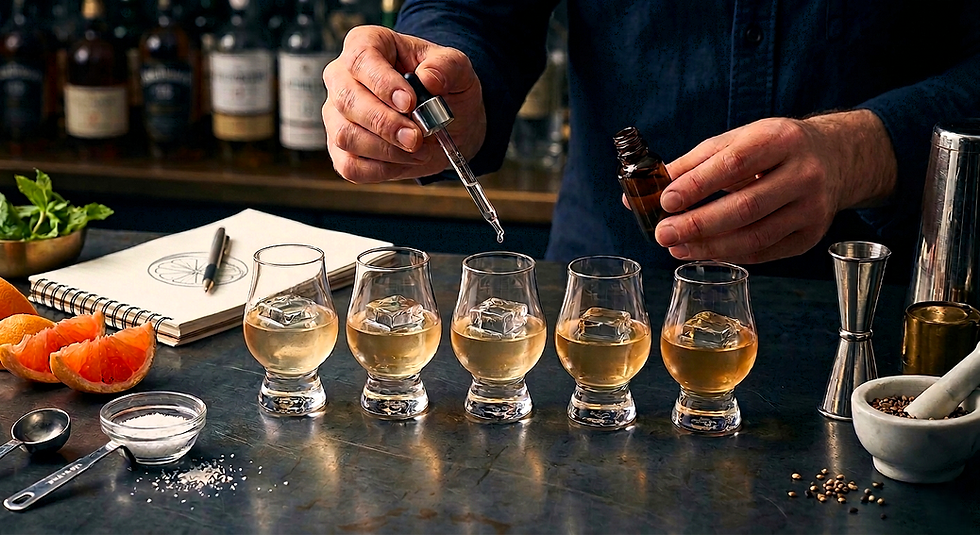
Prototype in small quantities. Keep the variables controlled. Record decisions. The point is not to prove the idea correct. The point is to learn where the design is weak.
A strong prototyping session usually follows this order:
12.1 Round 1: Structural Validation
Does the drink shape make sense at all? Is it in the right family? Does it feel like the right format for the brief?
12.2 Round 2: Sensory Adjustment
Acid, sweetness, bitterness, salt, alcohol load, texture, and finish are refined.
12.3 Round 3: Perception Alignment
Name, color, garnish, glass, ice, and aroma are adjusted to make the first impression more coherent.
12.4 Round 4: Service Reality
How long does it take? What needs prep? What fails when the bar is busy? What becomes inconsistent?
Change only one meaningful variable at a time whenever possible. If acid, sweetness, dilution, garnish, and glass all change at once, nobody learns what actually improved the drink.
Use the Prototype Iteration Tracker to document each version, log the variable changes, and stop good ideas from disappearing into memory.
13. How to Taste Prototypes Properly
Many bars say they “tested” a drink when they really just drank it. That is not the same thing.
A proper prototype tasting should ask a fixed sequence of questions:
13.1 First Impression
What does the guest expect from sight and aroma alone?
13.2 Entry
What happens in the first second of tasting?
13.3 Mid-Palate
Where is the weight? Is the center clear or blurry?
13.4 Finish
What remains? Does the finish invite another sip or shut the door?
13.5 Balance
What is over-speaking? What is under-speaking?
13.6 Identity
Would someone remember this drink tomorrow? If yes, why?
13.7 Fit
Does this belong on this menu and in this room?
That sequence is powerful because it separates simple liking from design evaluation. A drink can be enjoyable but wrong for the venue. A drink can also be technically sound but emotionally forgettable.
13.8 Advanced Sidebar: A Tasty Drink Is Not Automatically a Good Menu Drink
This is one of the most expensive confusions in beverage development. Many prototypes taste good in isolation. Far fewer deserve a position on a live menu. The menu version must survive repetition, guest explanation, staffing variation, prep cycles, and the pressure of comparison against every other drink on the page. A drink can be delicious and still not make the cut. That is not failure. That is editing.
14. Execution Is Part of the Recipe
A recipe is incomplete until it describes how the drink behaves in service. In other words, execution is not separate from design. It is part of design.
A beautifully balanced drink that requires unrealistic handling is a poorly designed menu item for most venues. That may sound harsh, but it is useful. It forces the designer to stop imagining perfect conditions and start imagining Thursday night.
Questions that belong in the design phase:
How many touches does this serve require?
Which touches are fragile or easily skipped?
Can one bartender make this properly while speaking to a guest?
What prep must be done before service?
What must happen to order?
What equipment bottlenecks does it create?
Does the garnish station slow the entire line?
What happens when the best bartender is off?
Does the drink still work if the soda is slightly less cold, the citrus is slightly different, or the ice is not textbook perfect?
These are not negative questions. They are professional questions.
A useful service rule is this: complexity is acceptable only when the value delivered is clearly greater than the cost imposed.
Sometimes that value is theater. Sometimes it is flavor. Sometimes it is guest memory. Sometimes it is brand identity. But the bar still has to pay for every extra touch in time, labor, storage, and training.
The Service Feasibility Checklist helps pressure-test a new serve before it creates hidden drag during live service.
14.1 Service Feasibility Score
Before finalizing a menu drink, score it from 1 to 5 in these categories:
speed
repeatability
prep burden
ingredient stability
glassware practicality
garnish control
training difficulty
guest clarity
If the drink scores poorly in three or more categories, it is not ready. It may need simplification, reformatting, or removal.
This is the stage where many drinks should be cut. That is healthy.
15. Write Better Specs So the Team Can Repeat the Drink
A spec sheet should not read like a private note from the creator to their future self. It should be a working operational document that another competent bartender can follow under pressure.
A strong spec includes:
drink name
one-line purpose or style cue
exact ingredients and measures
prep notes for any homemade or batched components
glassware
ice
method
garnish standard
final visual check
taste check
service cue, if relevant
That last point is often missed. If the drink needs a short explanation, the spec should say so. Example:“Guest cue: bright, dry, citrus-forward highball with gentle bitterness.”
That gives the team language. It reduces vague tableside selling.
A final visual check can be equally useful:“Should read pale pink-orange, bright, clean, no floating herb debris, peel aligned, ice fully packed.”
This level of detail is not obsessive. It is efficient. It prevents drift.
The Sensory Tasting and QC Sheet gives a simple station-ready way to keep tasting language, visual standards, and sign-off criteria aligned across the team.

16. Train the Team to Understand, Not Just Memorize
Memorization is necessary, but it is not enough. If the team only memorizes the recipe, every variable change becomes dangerous. If the team understands the drink, small corrections become possible.
Training should answer:
what the drink is trying to be
which note should lead
what the finish should feel like
which variables can be adjusted slightly
which variables are non-negotiable
what the garnish is doing
how the guest should understand the serve
For example, if the bartender knows a highball is supposed to finish dry and lively, they are more likely to notice when warm soda or weak ice pushes it soft and sweet. If they know the expressed peel is there to create the first aroma, they are less likely to treat the garnish as a random extra.
Better training reduces waste because the team stops making the same avoidable mistakes.
17. Menu Fit Matters More Than Isolated Brilliance
A drink does not live alone. It lives next to the other drinks on the menu.
This matters because a strong individual serve can still be a weak menu addition if it duplicates existing jobs. If the menu already has three bright citrus drinks, a fourth one may be technically good and strategically useless. If every serve is spirit-forward and serious, the menu may feel narrower than the audience wants. If every drink is visually loud, none of them feels special.
A good menu should usually vary across:
alcohol intensity
flavor direction
bitterness level
sweetness perception
texture
format
pace of drinking
guest familiarity
Think in roles:
crowd-pleaser
bartender’s choice
low-alcohol bridge
bitter adult aperitif
bright opener
darker closer
conversation starter
fast seller
hero signature
The point is not to force labels onto every drink. The point is to avoid designing five versions of the same job.
18. Commercial Logic Without Becoming Boring
Commercial awareness does not cheapen creativity. It disciplines it.
A drink should justify itself through some combination of:
strong guest response
efficient service
clear menu role
good margin behavior
strong identity value
low waste
training efficiency
Not every drink has to be the top seller. Some serves give a menu its voice. But every drink should at least earn its space.
Common commercial mistakes include:
designing for bartender admiration instead of guest re-ordering
building with unstable ingredients that create hidden loss
using expensive complexity where a cleaner design would sell better
ignoring prep time because it is invisible during R&D
forcing a niche flavor profile into a broad audience slot
If the venue wants a drink that sells all night, the design must respect that. If the venue wants one halo serve that communicates ambition, that design can take more risk. The mistake is confusing one job for the other.
19. Troubleshooting by Symptom
When a design fails, the symptom often points toward the real problem faster than another full rewrite.
19.1 It Looks Better Than It Tastes
Likely causes: weak structure, garnish doing all the work, color overpromising, drink under-seasoned, dilution off.
19.2 It Tastes Good but Guests Do Not Remember It
Likely causes: no clear identity, too familiar without a hook, name too generic, aroma forgettable, finish not distinctive.
19.3 Bartenders Avoid Making It
Likely causes: too many touches, awkward garnish, messy method, poor station fit, fragile execution.
19.4 The First Sip Is Exciting, Then the Drink Falls Apart
Likely causes: dilution curve wrong, carbonation fading too quickly, sweetness climbing as it warms, garnish not supporting the later sips.
19.5 Guests Ask What It Is Supposed to Taste Like
Likely causes: unclear concept, conflicting sensory signals, name disconnected from the liquid, too many competing ideas.
19.6 The Creator Loves It, the Room Does Not
Likely causes: audience mismatch, concept too internal, familiarity level too low for the slot, bitterness, acidity, or savory notes pushed beyond local preference.
19.7 It Only Works When One Bartender Makes It
Likely causes: undocumented corrections, hidden technique dependency, recipe too sensitive, training gap.
A good rule for troubleshooting is to diagnose the category of failure first:
structure failure
perception failure
service failure
menu-fit failure
training failure
Then solve inside that category before changing everything.
20. A Practical R&D Session SOP
Use this short SOP for a focused design session.
20.1 Before the Session
Write the brief.
Choose the structural family.
Define the hero ingredient or sensory hook.
Prepare only the minimum components needed for testing.
20.2 During the Session
Build three small versions, not one large “perfect” version.
Change one variable between versions.
Taste in the same order every time.
Record immediate notes before discussing.
Rank versions by fit, not only by pleasure.
20.3 After the Session
Select one lead version only.
Simplify it for service.
Rewrite the spec clearly.
Test again under realistic conditions.
Decide keep, revise, or kill.
The hardest part for many teams is that last word: kill. But dead ends are part of the process. Good design is not a straight line. It is disciplined selection.
21. Implementation in a Real Bar
Design is not complete when the liquid is good. It is complete when the drink can survive a rollout.
A practical implementation plan looks like this:
21.1 Day 1: Concept Sign-Off
Confirm the brief, the role on the menu, and the target guest.
21.2 Day 2: Prototype Lock
Choose the lead version and record the exact spec.
21.3 Day 3: Service Test
Run the drink during a controlled shift or internal practice session. Time the build. Watch for bottlenecks.
21.4 Day 4: Staff Calibration
Taste the reference version together. Agree on key descriptors, garnish handling, and fail points.
21.5 Day 5: Prep and Documentation
Finalize batch sizes, shelf-life assumptions, storage labels, and station setup.
21.6 Day 6: Soft Release
Offer the drink in a limited context, or sell it with close observation and deliberate note-taking.
21.7 Day 7: Review
Check sales, staff feedback, guest reactions, consistency, and build speed. Revise if needed.
That may sound formal, but it saves more time than it costs. Most rollout pain is just unpriced ambiguity.
21.8 Advanced Sidebar: Simplicity Is Not the Opposite of Creativity
Many bartenders only learn this after they have built too many overworked drinks. Simplicity is often the final shape of a solved problem. When a drink looks effortless, it may be because the design work already happened earlier, during the brief, the editing, the testing, and the removal of everything unnecessary. The guest receives ease. The designer earns it.
22. How to Know When a Drink Is Finished
A drink is not finished when there are no more ideas to add. It is finished when the remaining choices feel necessary.
Signs a drink is ready:
the concept is easy to explain in one sentence
the structure is clear
the first impression matches the taste
the finish supports another sip or the intended stopping point
the service method is realistic
the team can repeat it
the menu has a real use for it
there are no decorative parts that secretly carry operational cost without adding real value
Signs it is not ready:
it needs a long apology or explanation
the garnish is covering a weak aroma design
the recipe only makes sense in ideal conditions
the concept sounds stronger than the liquid
the creator is emotionally defending details that no longer improve the drink
23. What You Get in the Downloadable Pack
The downloadable pack is built to help move this Masterclass off the screen and into actual work.
The Double Strainer Masterclass - Cocktail Design
The full premium training file for reading, reference, and team study.
Cocktail Design Brief and Concept Worksheet
An editable worksheet to define the job, guest, environment, sensory target, and design constraints before R&D starts.
Prototype Iteration Tracker
A structured tracker for version numbers, variable changes, tasting notes, service
observations, and final decisions.
Service Feasibility Checklist
A fast operational check for speed, repeatability, garnish control, prep burden, and rollout
risk.
Sensory Tasting and QC Sheet
A clean station or training sheet to align visual standard, aroma cue, taste target, and pass-fail sign-off.
Prefer to download everything at once? Click Cocktail Design Masterclass Pack.zip to get the
complete pack in one file.
24. FAQ
What Is the Difference Between Cocktail Design and Cocktail Creation?
Cocktail creation is the act of making a new drink. Cocktail design is broader. It includes the purpose, sensory behavior, operational fit, and communication of the drink.
Should Every Signature Drink Start from a Classic Template?
Not every single one, but most bars benefit from doing so because it speeds up balance and improves legibility. Radical originality is easier to manage once the basics are under control.
How Many Components Are Too Many?
There is no fixed number, but if the drink needs many components and the guest cannot feel their value, the design is probably overloaded.
Can a Garnish Be Removed Completely?
Yes. A garnish is optional only if its job is optional. If aroma, identity, or visual clarity improve meaningfully without it, removal can be the better design choice.
How Much Should Guest Feedback Influence Revisions?
A lot, but not blindly. Guests reveal friction and preference. The team still has to interpret whether the feedback reflects a design flaw, an audience mismatch, or a menu-positioning issue.
Should Difficult Drinks Always Be Simplified?
Not always. Some venues trade on complexity and theater. The better question is whether the value created justifies the extra cost in labor, training, and risk.
How Often Should a Menu Drink Be Reviewed After Launch?
Early in its life, often. Review it after soft release, then again once real service patterns and guest reactions become clear.
25. Glossary
Design Brief
A short written definition of what the drink is for and the conditions it must satisfy.
Structural Family
The broad drink type that provides a recognizable balance framework, such as sour, highball, or stirred bitter serve.
Sensory Target
A concise description of the intended taste, aroma, texture, and finish.
Dilution
Water added through mixing, shaking, stirring, or melting ice. It is part of the recipe, not an accident.
Perception Cue
Any signal, such as color, aroma, glass, or name, that shapes expectation before tasting.
Service Feasibility
The likelihood that a drink can be executed cleanly and consistently under live conditions.
QC
Quality control. The checks used to confirm a drink is being made and served to standard.
Menu Fit
How well a drink supports the broader beverage program instead of only succeeding on its own.
To Go Deeper
Cocktail design gets even stronger when it is connected to deeper work on ingredients, dilution, carbonation, prep systems, and service structure. The most useful next steps usually live in the Techniques section, Ingredients section, Cocktails section, and Bar Business section on TDS.
Join The Double Strainer Newsletter and get the free Bar Essentials guide.Practical tools for better prep, smarter batching, and cleaner service.
Written by: Riccardo Grechi | Head Mixologist, Bar Consultant & Trainer


Comments